By Kekoa Paki
Hello reader
I recently added the piece “function” to the website. I put a lot of time and effort into this piece, and I think I did a fairly good job with it. So, I’d like to use this blog post to discuss the process of its creation and a few of the creative choices I made.
The process started when my aunt approached me and asked me to donate one of my paintings to a charity auction, she was involved with, the proceeds from which would go to Dementia research. You see, my aunt is a certified care practitioner. At first, she wanted the piece “Sunset Watcher,” but I thought it would be more fitting if I made a piece explicitly for the auction.
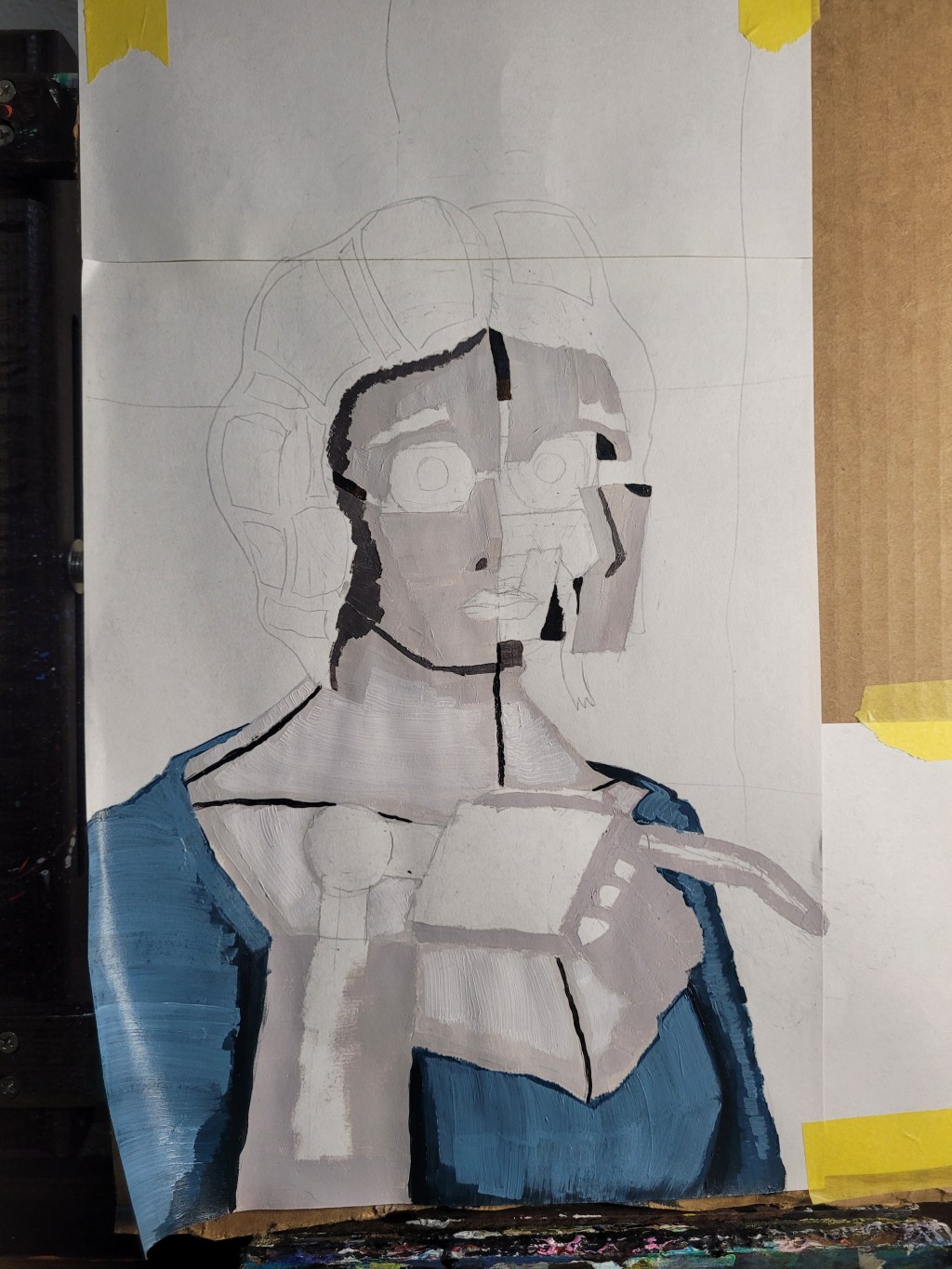
A WIP photo of “Function 1”:

I wanted the piece to be about Dementia, so I started looking into the condition. I read articles, watched YouTube videos, researched artists with Dementia (RIP William Utermohlen), and interviewed my aunt to learn more about the disease. Eventually, I felt like I had a good enough understanding of Dementia to start production of the piece.
A WIP photo of “Function 2”:
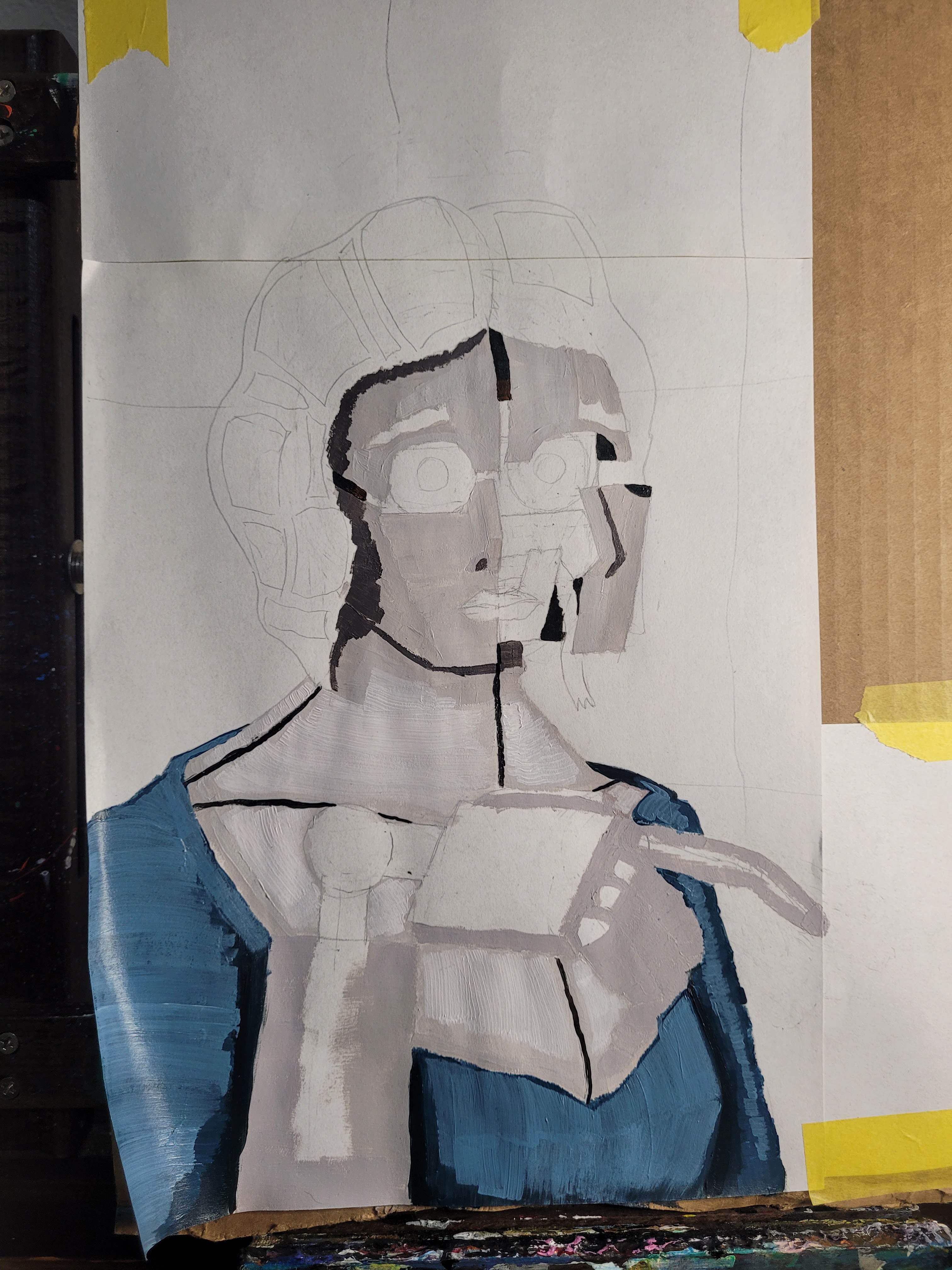
I knew I wanted the piece to encapsulate something about Dementia, but because Dementia is such a broad condition, I knew I was going to have to narrow my focus to a certain aspect of it. At first, I contemplated emphasizing how Dementia takes away a person’s memories of their life, but I ended up deciding to focus on the loss of function and autonomy that often comes with Dementia.
Dementia often strips patients of their bodily autonomy. It becomes harder to concentrate, simple tasks become difficult, and more and more patients lose the ability to do things for themselves. I heard Dementia likened to “brain failure,” and found that very interesting. It reminded me of how machines broke and became inoperable. I became very interested in the parallels between Dementia and the degradation of machines overtime.
One idea I had when I was debating what the focal point of the project would be was the concept of three backgrounds that would show the slow decline of a Dementia patient’s mental faculties. The first background would show many intricately written documents, showing how vibrant the inside of the patient’s mind was. The second background would display shorter choppier sentences, showing how the patient was having a harder time concentrating and was getting confused and scared. The third portrait would be a static blizzard of nothingness apart from a single desperate question, showing the depths of despair and panic the patient had been brought to by their condition.
A WIP photo of “Function 3”:
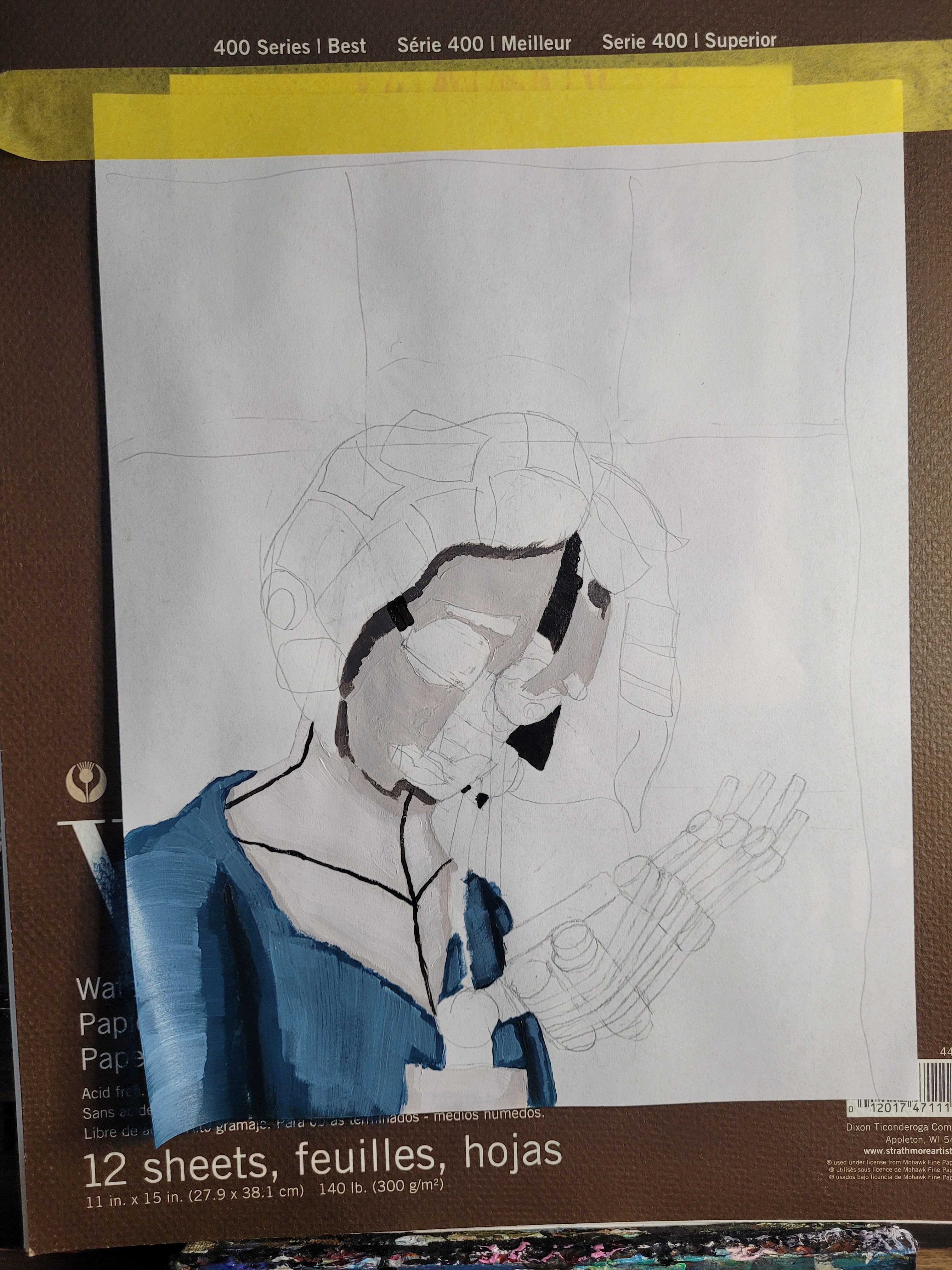
With the concepts of failing machines and sheets of paper in mind, I got the idea of a rusty, ink-leaking typewriter as a unifying motif for the piece.
Originally, I considered using an actual Dementia patient as my muse, but that felt somewhat mean-spirited. So, I decided to make my own character who I would depict in the piece.
Notes made during the creation of “Function”:
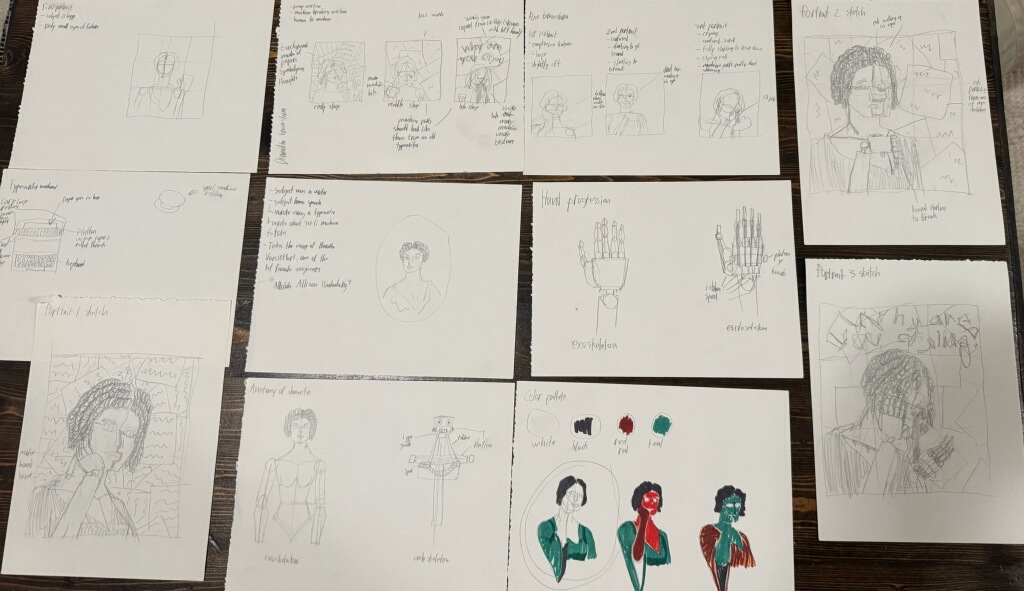
I decided to call the character Anna Hindenburg; I named her after the Hindenburg disaster to tie into the theme of failing machines. I imagined her as a sci-fi writer who wrote about futuristic machines, was born one year after the Hindenburg disaster, and suffered from and was eventually killed by Dementia. I heavily based her appearance on that of Henrietta Vansittart, one of the most famous engineers of all time.
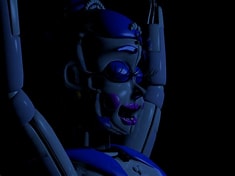

I portrayed Anna as a robot to more clearly show how her Dementia robbed her body of its function. For the makeup of her robotic components, I took a large amount of inspiration from the work of Scott Cawthon. Particularly his endoskeleton design from “Five Nights at Freddy’s” and the designs of the “Funtime” animatronics from “Five Nights at Freddy’s: Sister Location.” Additionally, I incorporated typewriter parts into the composition of her endoskeleton to relate to the typewriter motif mentioned earlier.
I decided to make Anna’s robotic parts orange to invoke ideas of rust and old failing machines. I made her dress teal for a similar reason and also to contrast the orange endoskeleton. I made her skin white to contrast the black of her hair and the ink. I made her lips red to compliment the orange and contrast the teal and I made her eyes blue to contrast her lips and her endo skeleton.
I wrote several documents to serve as the backgrounds for the pieces as we discussed earlier. I wrote the pieces for the first portrait as documents that Anna had written in Universe, and I wrote the documents for the second portrait as thoughts Anna was having. I researched how Dementia patients lost the ability to speak languages besides their native tongue and decided to incorporate that into Anna’s letter to Ellen Ochoa, another character I made for the piece who I named after a famous engineer.
As for the hair, I tried to replicate the way Tamara de Lempicka rendered hair. Lempicka is an artist whose work I enjoy a lot and who I deeply admire. In the third piece, I tried to paint the hair to resemble mechanical springs, I did this to tie into the broken machine theme.
Just a few more things before I wrap this post up:
- The piece is called “Function” to cause the viewer to think about how Anna loses her body’s function over the three paintings.
- Over the course of the piece, Anna’s eyes and lips get darker, this is meant to invoke how in animated shows when a character dies, they lose the highlights in their eyes. The life literally leaves their eyes.
- The phrase “Why are you crying?” is repeated throughout the piece. This is supposed to call to mind the idea of a caretaker not knowing why Anna is upset about something and of Anna stumbling onto one of her loved ones crying over her condition.
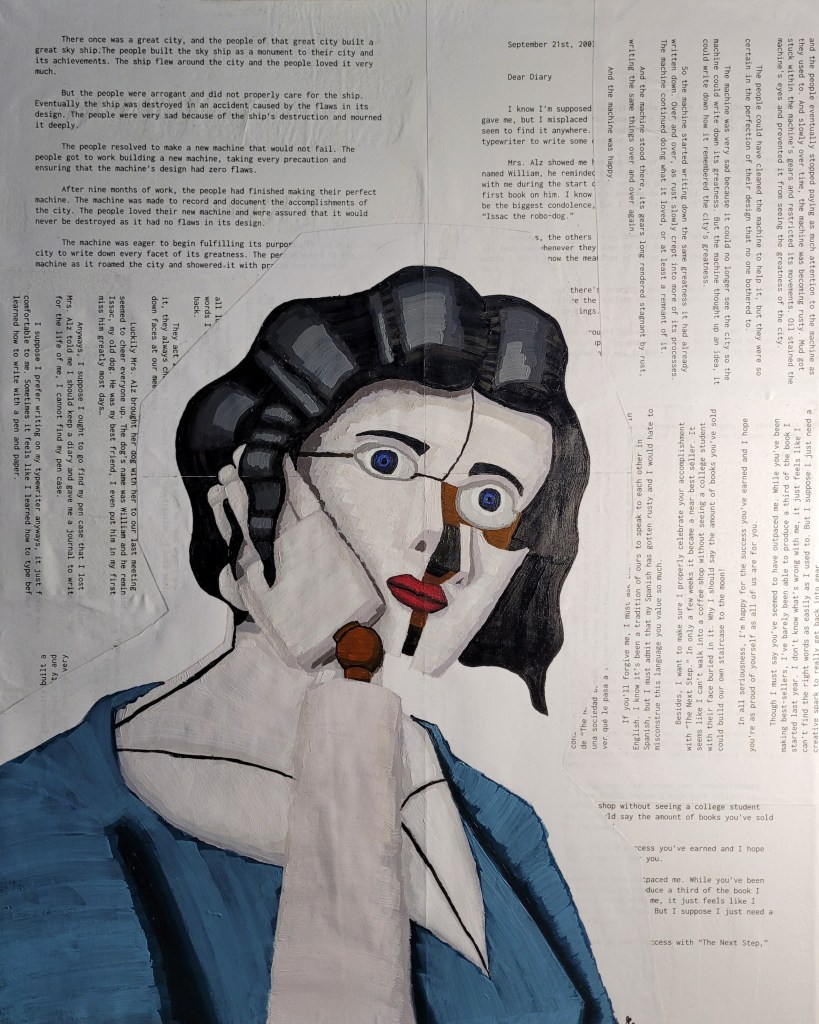
Function 1
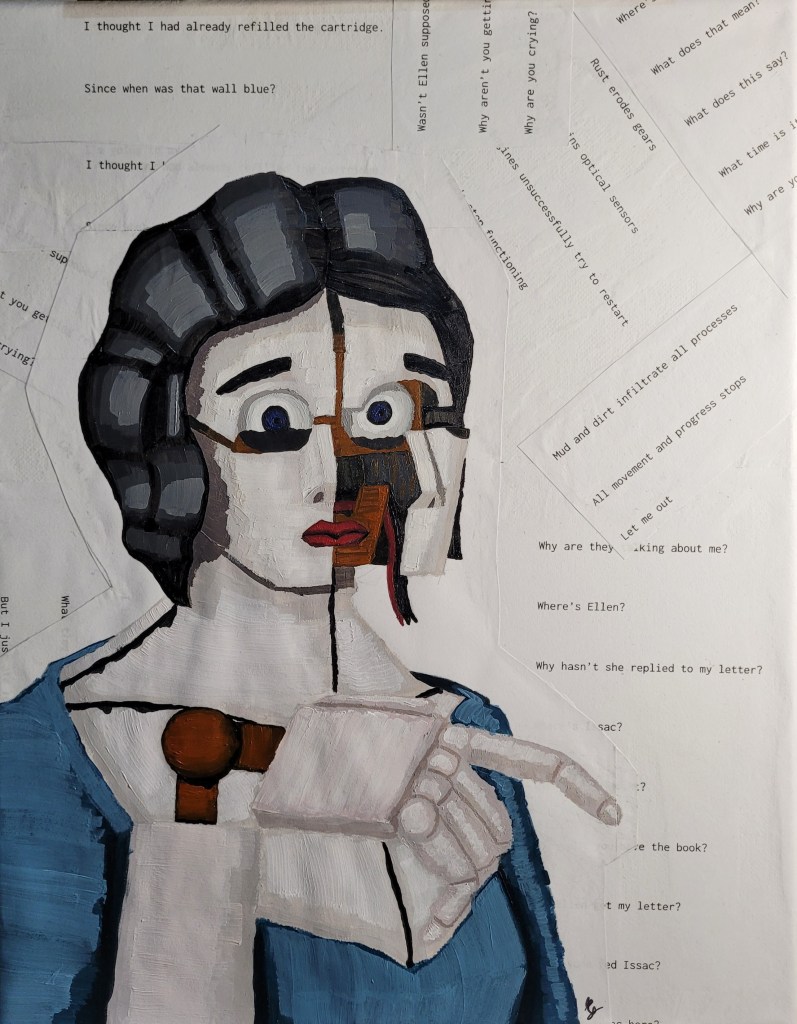
Function 2
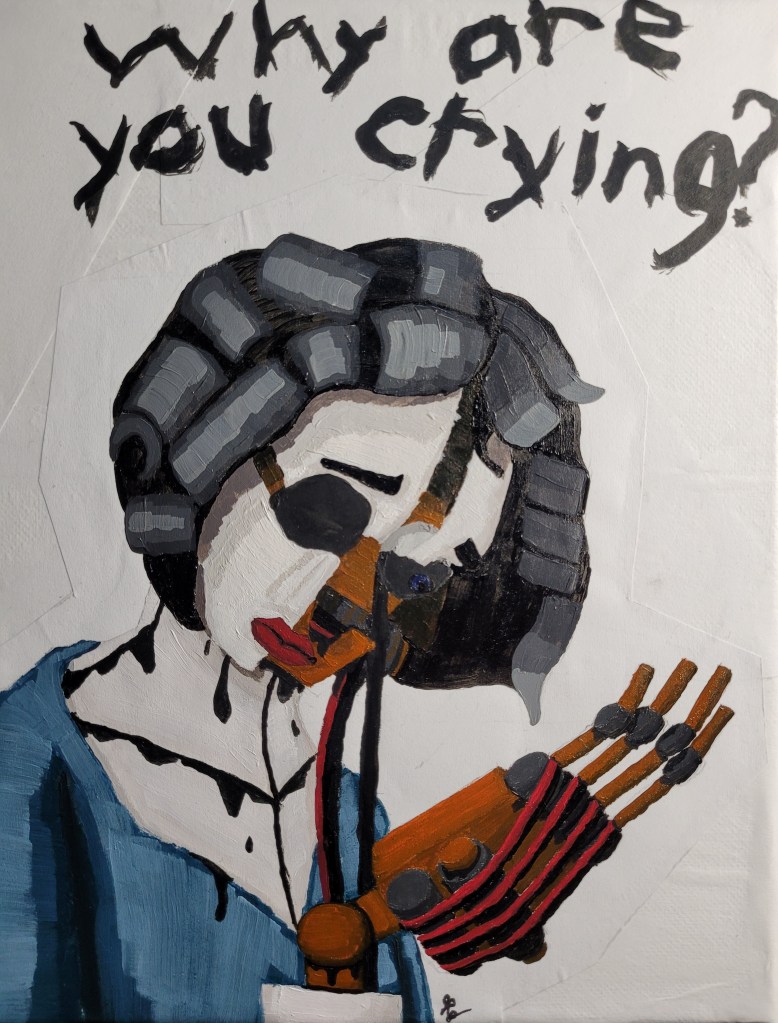
Function 3
I think that’s enough discussion of this piece for the day. Thank you, viewer, for reading this blog post. I do apologize if it was somewhat ramble-y, I’m still new to this whole blogging thing. Feel free to contact me if you have any questions about the creative process behind “Function,” or any of my other pieces.
Have a good day.
From,
Kekoa Paki

 Kekoa Paki Arts
Leave a comment