Hello Reader,
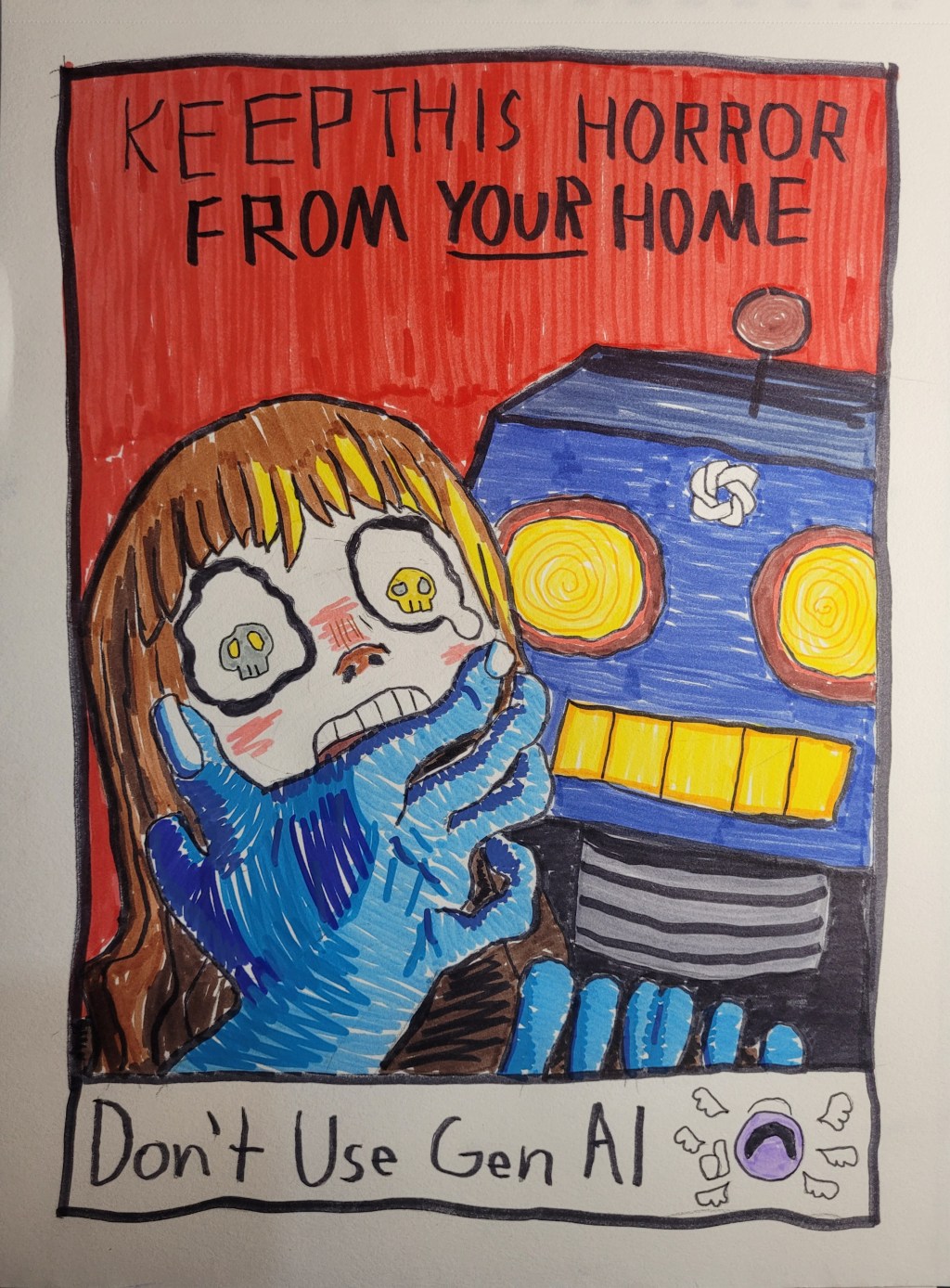
I hate generative AI, and in this blog post I’m going to tell you why I hate generative AI, and why you should hate it too.
Firstly, let us define the term generative AI, which I will refer to as GenAI in the majority of this text. I define it as any algorithm which inputs text, images, videos, or other media, and then splices that media up into their most common facets to create output text, images, or videos, usually in response to prompts. Examples of GenAI include Chatgpt, Midjourney, and Grok. Notably, I do not consider all algorithms generative AIs. An algorithm is only a generative AI if it outputs media like images, videos, or texts, by copying aspects of its input data.
Do forgive me if that definition might not be the most accurate to industry standards. I’m not an expert on GenAIs, nor do I feel I should have to be to know what they are and hate them for it. One need not be an expert on something to know the damage that thing causes and be morally justified in hating it and advocating for its eradication. I would be justified in making a similar argument about Nazism as a political ideology. I’m not an expert on Nazism, but I’m still morally justified in advocating for its destruction. While the rationale behind despising GenAI may not be as obvious as literal Nazism, it is very pertinent, nonetheless.
There are many reasons as to why you should hate GenAI, one being that it is built on a foundation of theft and plagiarism. GenAI models require an insane amount of training data in order to function. According to a report on GenAI written by the US Government Accountability Office, “Generative AI typically requires a large dataset for training—ranging from millions to trillions of data points” (8). These data points are the things AI models replicate to generate “new” images (Our World in Data). For example, if you wanted to build a model to replicate images of ducks, you would input into it a lot of pictures of ducks. In that scenario, one duck image would be counted as one data point.
These data points are overwhelmingly taken from artists without their consent. An example of this can be found in the Ghibli AI filter trend popular during March of this year. Hayao Miyazaki, co-founder of the animation house, has long been open about his and his studio’s anti-AI views (Manhattan Project…). All the same, the style they had crafted over years in their filmmaking history was used as a data source by AI companies without consent or compensation, as was detailed in a report written by Dani Di Placido of Forbes. This example is one of millions of artists having their work reduced to data points for machines made to dispense replications of their work. Though that’s not to say that only artists suffer from this technology’s existence.
Generative AI models are very destructive to the environment. The data centers which house these models consume an insane amount of water and energy. According to a report by UCL Economics Professor Mariana Mazzucato, ” Large language models such as ChatGPT are some of the most energy-guzzling technologies of all. Research suggests, for instance, that about 700,000 litres of water could have been used to cool the machines that trained ChatGPT-3 at Microsoft’s data facilities.” For reference, that’s roughly 225 times what the average American uses in a day at home. These centers consume a significant amount of local resources, while polluting their surrounding environment, all at the expense of the people who live in nearby communities (Han, Yuelin, et al). And yet, there are still many more moral and rational reasons to hate AI, such as its displacement of human workers or its normalization of plagiarism in academic settings. But I feel there is one reason above all others to hate AI.
AI is anti-human. The entire purpose of humanity is to make art, express ourselves, and connect with others. To suggest we should outsource the creative process to a machine is nothing less than blasphemous. It is to strip the wings from the bird, the fins from the fish, or the legs from the cow. It is cruelty in its purest form. The very concept of generative AI is inherently immoral, as its existence brings about nothing but pain to all who use it and all who are used by it. It is anti-human, anti-art, anti-cooperation, anti-passion, and anti-love. It is for this reason I hate generative AI, and it is for this reason you should hate it too.
Sources:
U.S. Government Accountability Office. Artificial Intelligence: Generative AI Training, Development, and Deployment Considerations. GAO-25-107651, October 2024, https://www.gao.gov/assets/gao-25-107651.pdf
Datapoints Used to Train Notable Artificial Intelligence Systems. Our World in Data, 2025. https://ourworldindata.org/grapher/artificial-intelligence-number-training-datapoints
Hayao Miyazaki’s Thoughts on Artificial Intelligence. Manhattan Project For a Nuclear-Free World, 2016. https://www.youtube.com/watch?v=ngZ0K3lWKRc&t=10s
Placido, Dani Di. The AI-Generated Studio Ghibli Trend, Explained. Forbes, 2025. https://www.forbes.com/sites/danidiplacido/2025/03/27/the-ai-generated-studio-ghibli-trend-explained/
Mazzucato, Mariana. The Ugly Truth Behind ChatGPT: AI is Guzzling Resources at Planet-Eating Rates. The Guardian, 2024. https://www.theguardian.com/commentisfree/article/2024/may/30/ugly-truth-ai-chatgpt-guzzling-resources-environment
Han, Yuelin, et al. The Unpaid Toll: Quantifying the Public Health Impact of AI. Cornell University, 2024. https://arxiv.org/pdf/2412.06288
From,
Kekoa Paki
 Kekoa Paki Arts
Leave a comment