Hello, Viewer
During my first quarter at Western Washington University, I took a class called “Visual Dialogue,” though I think it’s more accurately described as a contemporary art history class. I found the course very insightful, most of my academic career I’ve been learning about the same old names in art canon, Rembrandt, Picasso, Van Gogh, etc. Not to say those lot aren’t good artists, but they are very heavily emphasized in art education, perhaps overemphasized. This course introduced me to some new artists, Postcommodity, the Guerrilla Girls, Randy Lee Cutler, etc. Additionally, it revealed sides to members of art cannon I hadn’t known about before. Case in point, apparently Duchamp had a female alter ego named Rrose Sélavy, and none of my art history classes thought to tell me about it, which seems somewhat dishonest to me. I mean, like, that seems like it might be an important part of his personhood that would be really insightful to have in mind when analyzing some of his work. But what do I know, I guess?
Anyways, the reason I bring this up is because one of the assignments I had to complete for that class was a “redux” of an existing artwork we’d discussed in class, a piece of art that was in conversation with the original work. I chose to appropriate the Cut Piece by Yoko Ono into a performance artwork I would come to call Human Canvas, and I would like to use this blog post to discuss the making of that piece with you.
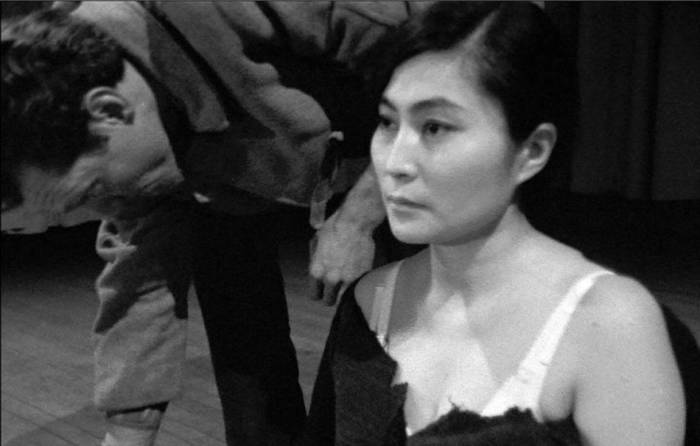
For context, the Cut Piece was a performance Yoko Ono did several times throughout the latter half of the 20th century. During the performance, Yoko Ono would sit completely still and allow members of the audience to cut off her clothes. Here’s a video of one of the performances she did: https://www.bing.com/videos/riverview/relatedvideo?&q=Cut+Piece&&mid=56BB89DAFB67FBEB6FA456BB89DAFB67FBEB6FA4&&FORM=VRDGAR
Picture from one of Yoko Ono’s Cut Piece performances:
While contemplating what I would do for the “Redux” assignment, I got the idea to combine Yoko Ono’s Cut Piece with my artboards. Those who’ve been following this website for a while should know what an artboard is, but for any newcomers: an artboard is a piece of public art I like to set up at any public events I go to. It’s just a whiteboard on which anyone can draw anything they like. I like to think of it as a little way to allow those with fewer resources than me engage in art, even if just a small bit. The synthesis of Yoko Ono’s Cut Piece with my Artboards eventually led to the Human Canvas performance.
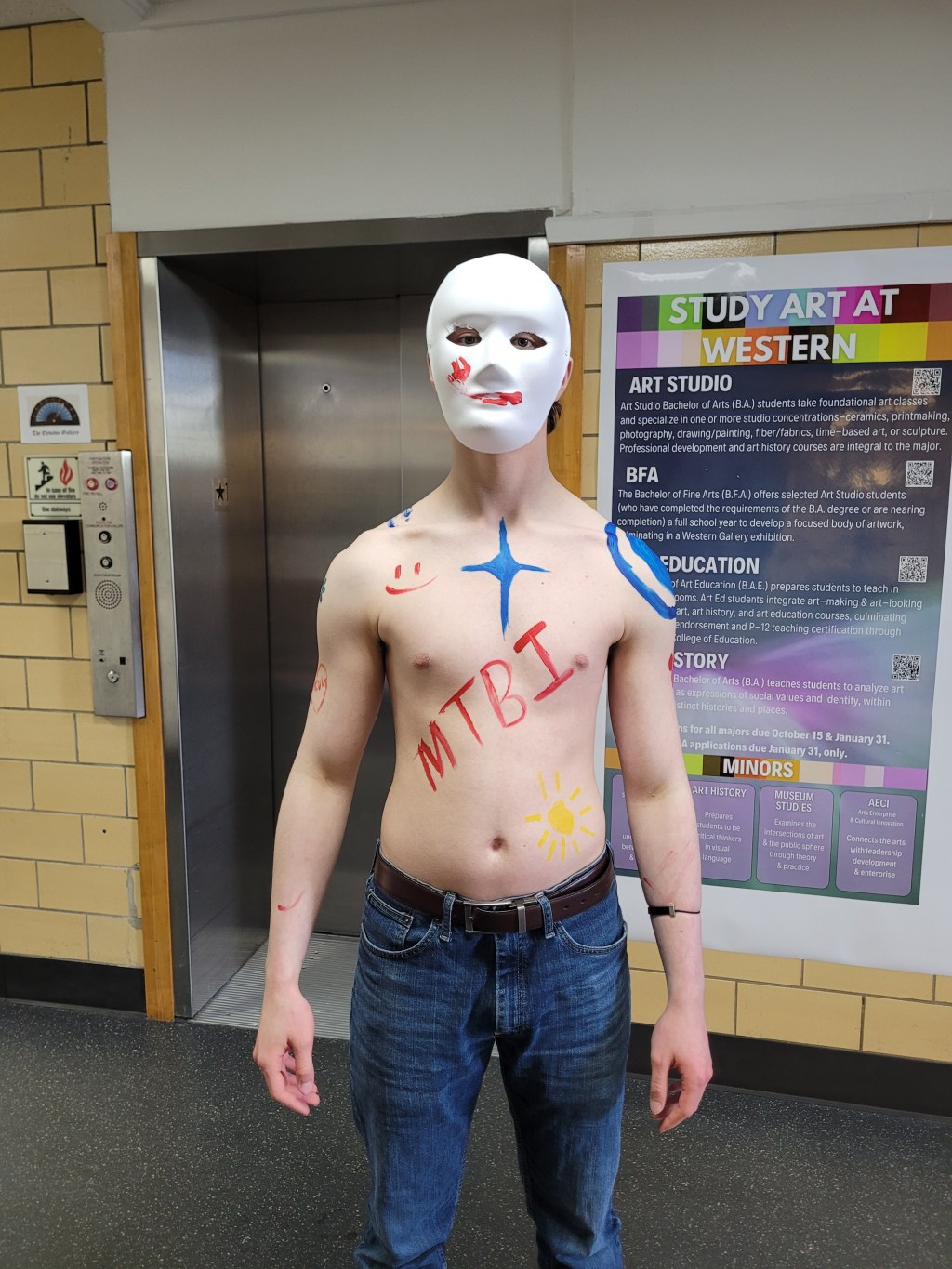
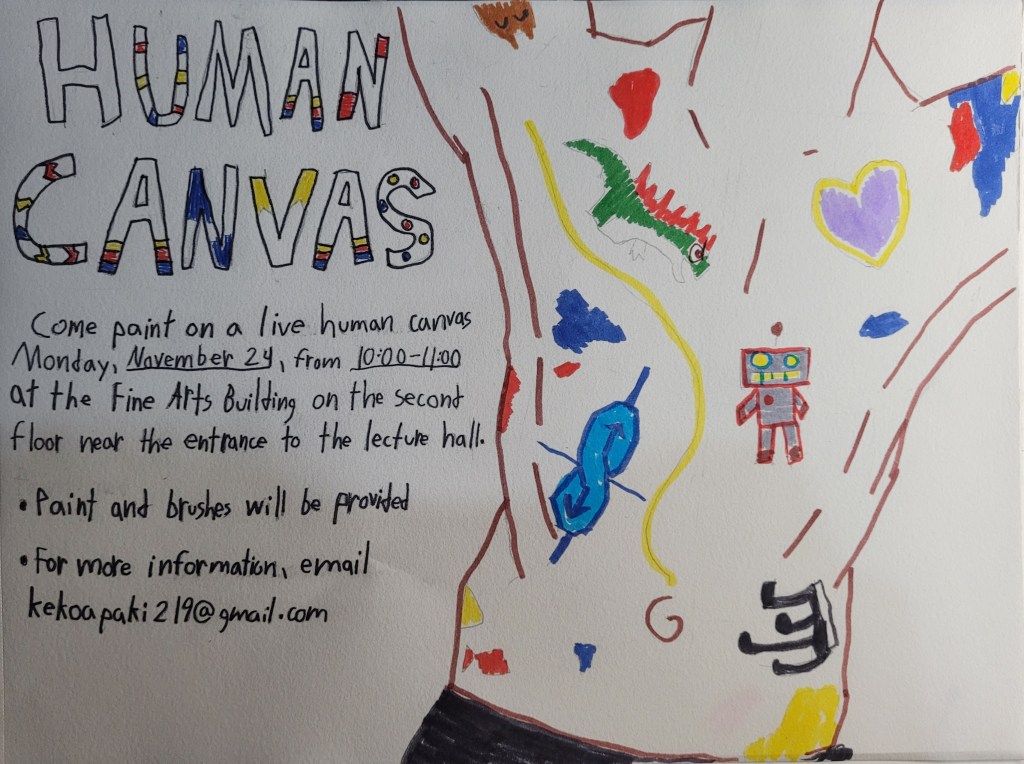
The Human Canvas performance was an hour-long event that took place on the second floor of the Fine Arts Building near the lecture hall. During the event, I stood on 2 large sheets of paper and was shirtless and wearing a white mask. People were allowed to paint whatever they wanted on my body above the waist. I didn’t talk during the performance, instead communicating with body language, this turned out to be one of the most fun parts of the performance for me. While there weren’t any people painting me, I would do fancy poses I remembered from anime and other media.
Poster I made for the Human Canvas Performance:
Sign I made for the Human Canvas Performance:
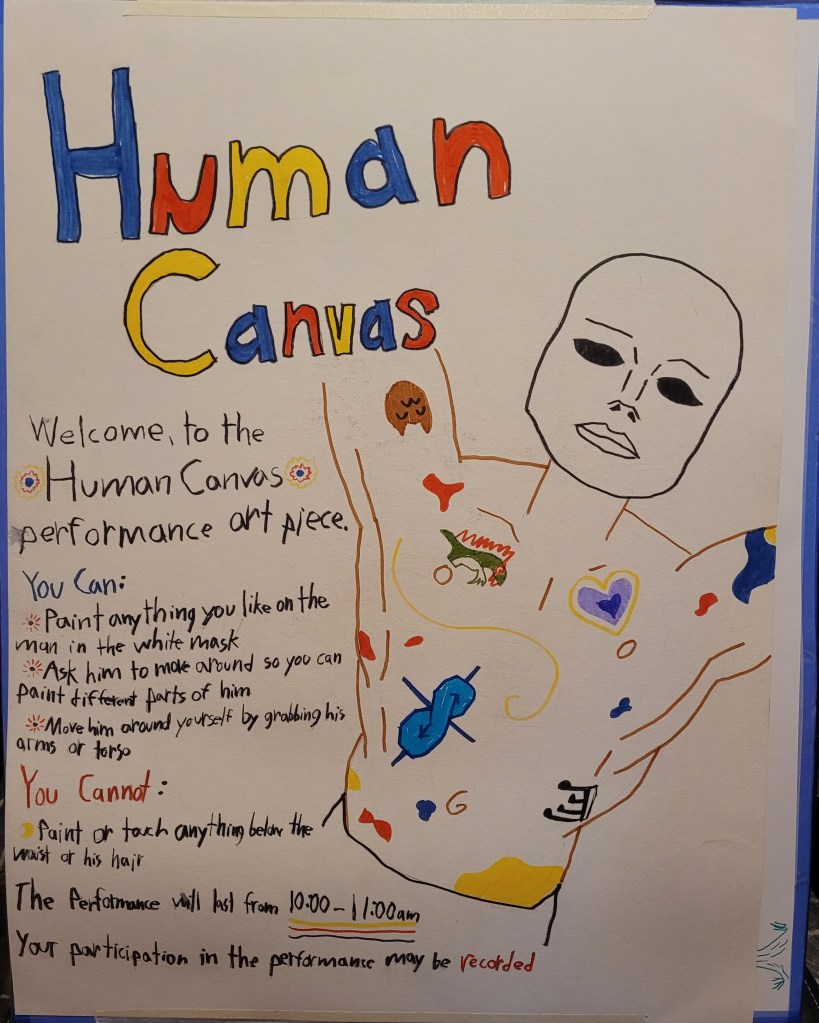
I had gotten approval for the event from the heads of the art department a week in advance. Due to how busy I was with classes and having my study abroad get canceled, I wasn’t able to make as many advertisements as I wanted for the piece. I was able to make a poster, but I didn’t get the chance to make any copies of it, and I was only able to post a picture of it on my Instagram 2 days before the performance. Though a fair few people did end up engaging with the event, as I set up in a place that got a lot of foot traffic. I finished making a sign for the event only 30 minutes before it started. It clarified the rules of the event and that viewers were allowed to move me around by grabbing my arms and torso, but no one ended up grabbing me like that.
There are a fair few things I learned through the performance I feel are worth noting. Firstly, it was predominately women who came up to paint me. Throughout the entire performance, only three men came up to paint me, two of which were teachers and the other one was accompanying a woman who came up to paint on me. I expected the opposite to happen, I expected more men to come up and women to generally shy away more. I thought that men would be more comfortable interacting with someone of their same sex and women would be a bit more scared by the tall man in the white mask voguing in the hallway.
I realized during the event that communicating exclusively with your body language is actually kind of fun. It forces you to think about interacting with others in a different way. Early in the event, a photographer came up and took a few photos of me with a professional camera. I wanted to ask her if she could send me images of the photos when they were completed, but I couldn’t ask her directly. I ended up holding up one finger and then pointing to my wrist as if pointing to a watch. I was trying to say nonverbally, “1 minute, please.” I then ran to the art education classroom where I had put my stuff during the event and got the poster I’d made for the performance, which had my email address on it. I then ran back to where I set the event up, she stopped me while running so that she could take photos of me in a running pose. Then finally, I pointed at her camera and then to my email address, which she seemed to understand and she said she would. Months later, she still hasn’t sent me copies of those photos, which I am kind of mad about.
There were a lot of differences between my work and the original Cut-piece by Yoko Ono. One of the differences I think is most notable doesn’t actually lie in the differences between the pieces’ concepts. It is the fact that Yoko Ono was a woman and I am a man. This significantly changes the power dynamics of the piece. The audience wouldn’t see me as being as vulnerable during the exhibition as they would’ve seen Yoko Ono. This is added onto by the fact that I moved during the performance, doing poses throughout the event and positioning in ways that made it easier for viewers to paint on me. This must have made it harder for people to objectify me than it was for people to see Yoko Ono as an object. Though, that may have been complicated by the mask I was wearing. Yoko Ono could be seen as an object with a human face and I could be seen as a human without a face. Additionally, Yoko Ono’s piece was subtractive, people took away from her, while mine was additive, people gave something to me by painting on me.
There were a fair few differences between my work and the original Cut-piece by Yoko Ono. One of the differences I think is most notable doesn’t actually lie in the differences between the pieces’ concepts. It is the fact that Yoko Ono was a woman, and I am a man. This significantly changes the power dynamics of the piece. The audience wouldn’t see me as being as vulnerable during the exhibition as they would’ve seen Yoko Ono. This was added onto by the fact that I moved during the performance, doing poses throughout the event and positioning in ways that made it easier for viewers to paint on me. This must have made it harder for people to objectify me than it was for people to do so to Yoko Ono. Though, that may have been complicated by the mask I was wearing. Yoko Ono could be seen as an object with a human face and I could be seen as a human without a face. Additionally, Yoko Ono’s piece was subtractive, people took away from her, while mine was additive, people gave something to me by painting on me.
Photos of myself after the performance:
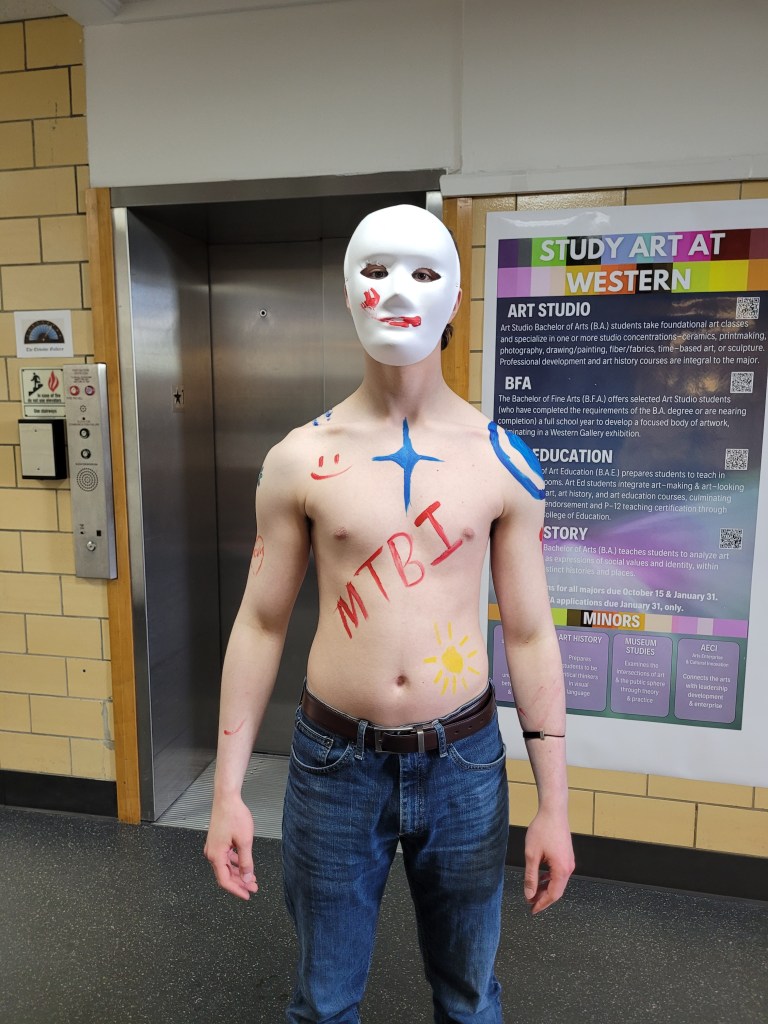
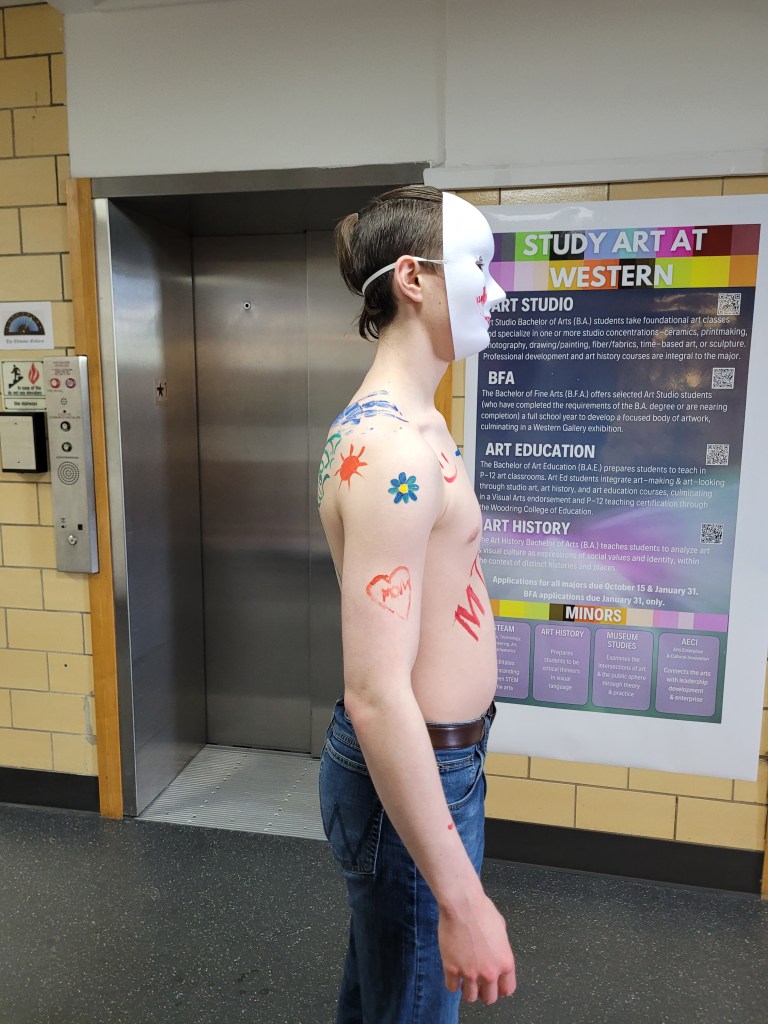
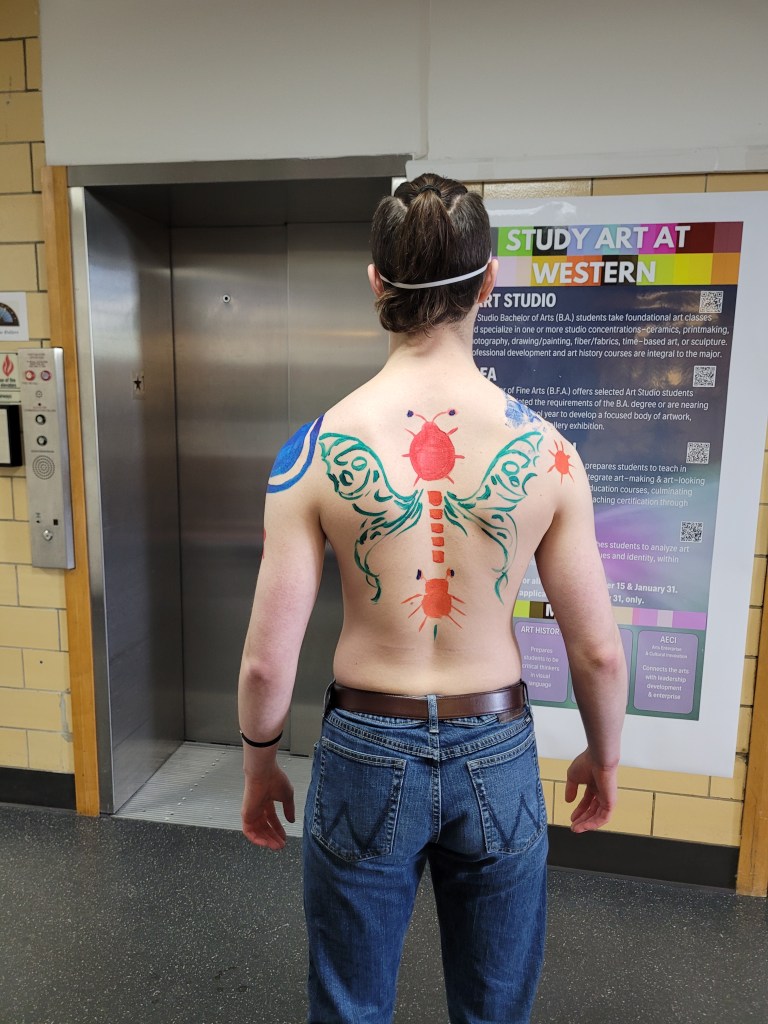
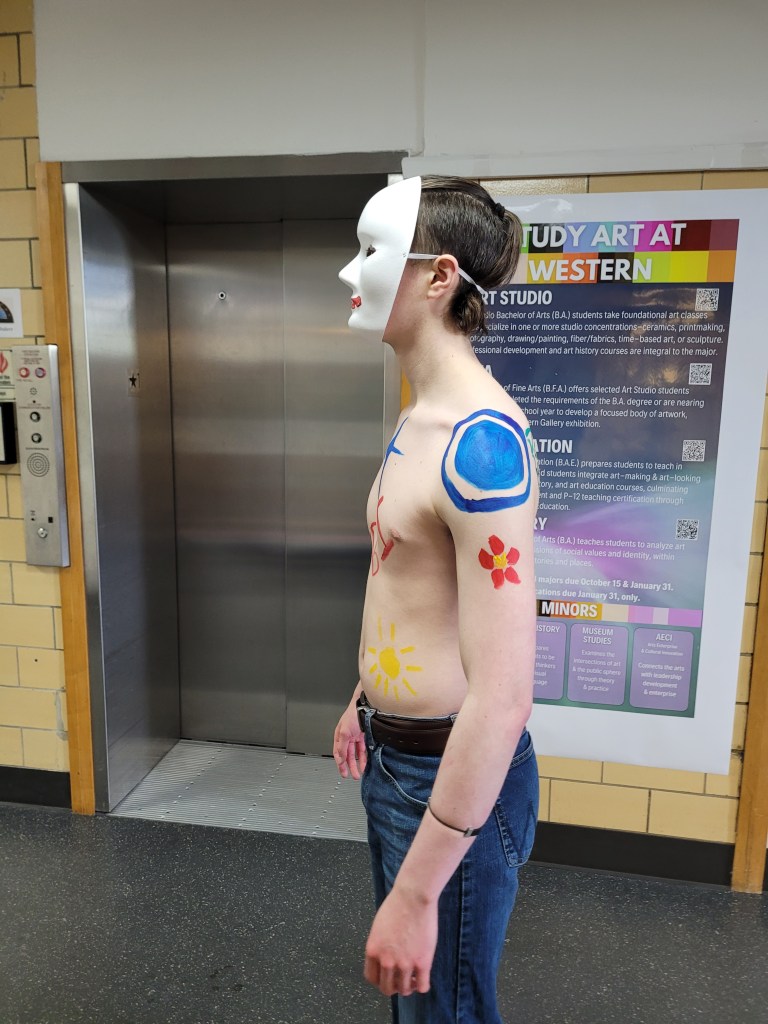
Overall, I had a lot of fun making this piece. It was my first foray into the medium of performance and I found it very interesting. I hope to do more performance art pieces in the future, whether they be repetitions of Human Canvas or other works.
Anyways, thanks for reading this blog post.
From,
Kekoa Paki
 Kekoa Paki Arts
Leave a comment